Software Architecture
NIM Studio is designed as a modular, local-first desktop platform for neuroinformatics, research data management, and reproducible scientific workflows. Rather than providing a single monolithic application, the software consists of independent modules that share a common infrastructure while remaining interoperable.
The architecture emphasizes transparency, extensibility, and data safety, allowing researchers to organize, curate, validate, and audit research data without relying on external cloud services.
Architectural Principles
NIM Studio is developed around six core principles:
Local-first processing – All operations are performed on the user’s workstation unless explicitly configured otherwise.
Modularity – Individual tools can operate independently or be combined into complete workflows.
BIDS compatibility – Dataset organization follows established neuroimaging standards wherever applicable.
Reproducibility – Generated outputs are deterministic, documented, and suitable for reproducible research.
Interoperability – Standard file formats and metadata schemas facilitate integration with existing neuroinformatics ecosystems.
Scalability – The framework supports both small laboratory projects and large collaborative research infrastructures.
System Architecture
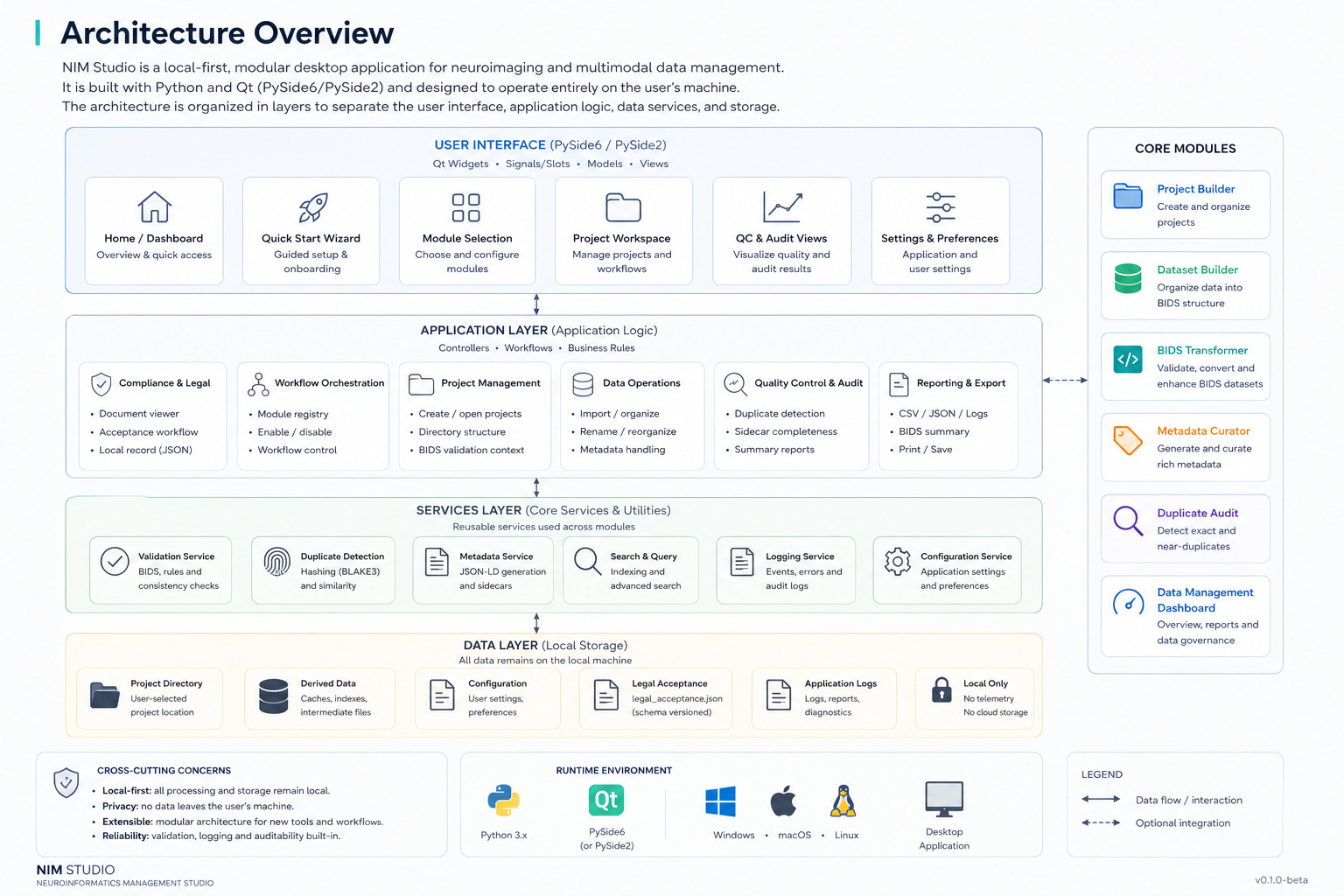
The application is organized into several architectural layers.

High-level architecture of NIM Studio.
User Interface
The graphical user interface provides access to all available modules through a common workspace. Users configure projects, select workflows, monitor progress, and review generated outputs without requiring command-line interaction.
Application Layer
The application layer coordinates user workflows, project management, validation routines, reporting, and communication between modules. It provides the central orchestration logic while remaining independent of any specific scientific workflow.
Core Services
Several reusable services are shared across all modules, including:
Metadata generation
Duplicate detection using BLAKE3 hashing
BIDS validation
Logging and reporting
Configuration management
Search and indexing
These shared services ensure consistent behaviour throughout the application.
Local Data Layer
NIM Studio stores all project information locally. Depending on the selected modules, the data layer may contain:
Research projects
BIDS datasets
Metadata files
Reports
Configuration files
Application logs
No external storage is required for standard operation.
Module-Based Design
Each major capability of NIM Studio is implemented as an independent module. Current beta modules include:
Project Builder
Dataset Builder
BIDS Transformer
Metadata Curator
Duplicate Audit
Data Management Dashboard
Modules share a common infrastructure while remaining loosely coupled. This design allows new functionality to be added without affecting existing components and enables users to construct workflows tailored to their research needs.
Benefits
The modular architecture provides several advantages:
Simplified maintenance and development
Consistent user experience across tools
Reusable services shared between modules
Easier integration of future functionality
Improved software scalability
Long-term sustainability of the platform