Data Hierarchy
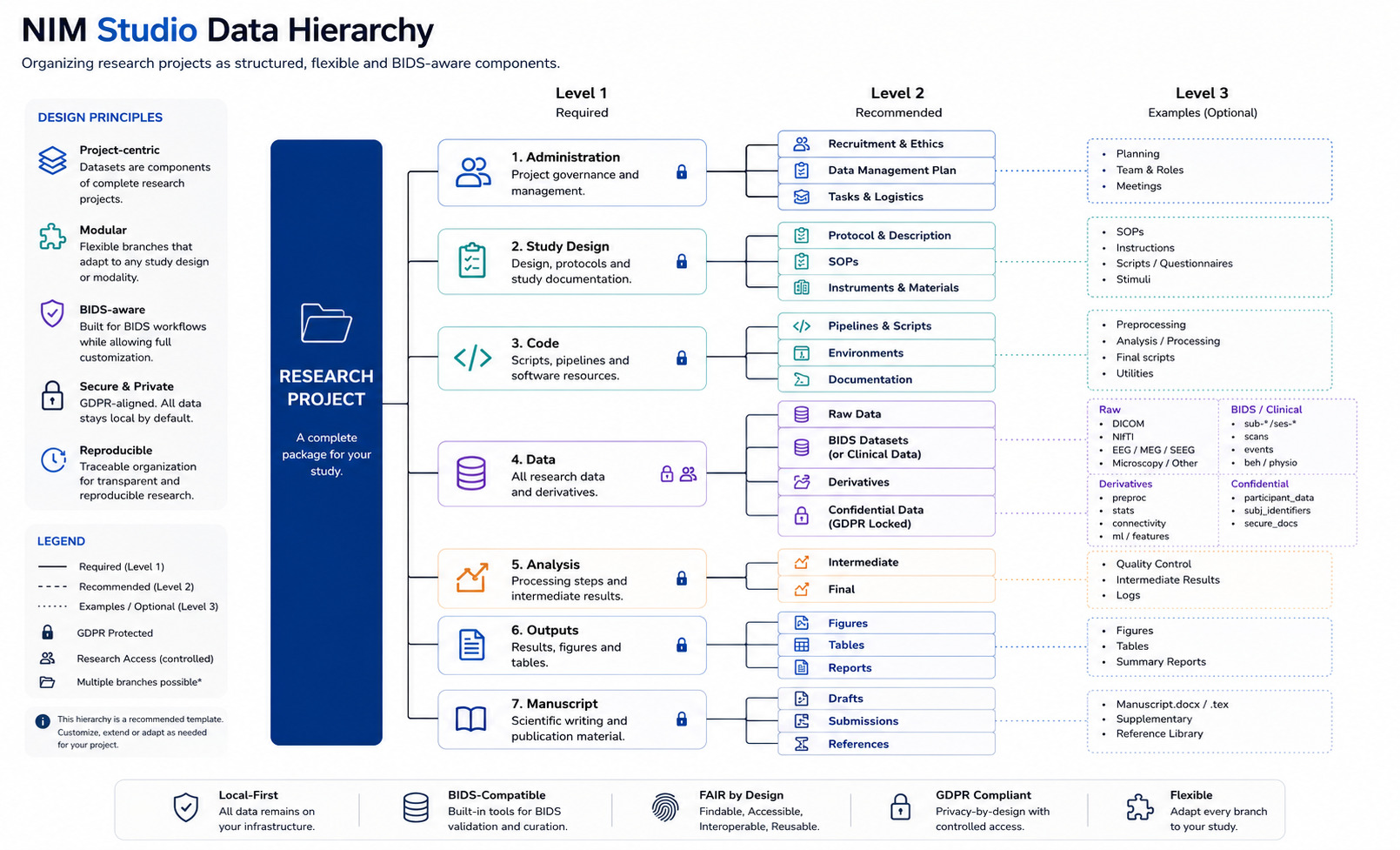
Proposed hierarchical organization of research projects in NIM Studio.
NIM Studio organizes research using a project-centric hierarchy. Rather than treating datasets as isolated entities, datasets are considered components of larger research projects that also include study administration, documentation, analysis pipelines, outputs, and scientific dissemination.
This approach encourages standardized project organization while remaining flexible enough to accommodate the diverse requirements of modern neuroinformatics and multidisciplinary research.
Project-Centric Design
The fundamental organizational unit within NIM Studio is the research project. Each project represents a complete scientific package that may contain one or multiple datasets together with all associated documentation, code, analyses, and outputs.
Typical project components include:
Administrative documentation
Study design
Source code and analysis pipelines
Research datasets
Intermediate processing
Final analyses
Figures and tables
Manuscripts and publications
Reference material
This structure aims to keep all research assets organized throughout the entire research lifecycle.
Datasets as Project Components
Within each project, datasets are managed as independent components. Depending on the study design, a project may contain:
A single dataset
Multiple datasets
Longitudinal cohorts
Multi-site studies
Multi-modal acquisitions
External reference datasets
Derived datasets generated during processing
This modular approach enables projects to evolve naturally without requiring changes to the surrounding project organization.
Support for BIDS
NIM Studio has been designed with the Brain Imaging Data Structure (BIDS) as its primary organizational framework for neuroimaging datasets.
Dedicated modules assist researchers in:
Building BIDS-compatible datasets
Transforming existing datasets into BIDS
Validating BIDS compliance
Organizing derivatives
Generating metadata and sidecar files
When datasets follow the BIDS specification, NIM Studio preserves the standard directory hierarchy while integrating it seamlessly into the broader project structure.
Flexible by Design
Although BIDS serves as the preferred standard for neuroimaging workflows, NIM Studio is intentionally not restricted to a single organizational model.
Researchers may adapt project structures according to the specific needs of:
Research laboratories
Clinical studies
Student projects
Teaching environments
Pilot studies
Large collaborative consortia
Multi-centre cohorts
Multi-modal research designs
Non-BIDS datasets
Individual folders, branches, and metadata structures can therefore be extended or customized without affecting the remainder of the project.
Recommended Hierarchy
The hierarchy shown above illustrates a recommended organizational template rather than a mandatory directory structure.
Level 1 folders represent the core components required by most research projects.
Level 2 folders provide a standardized organization suitable for the majority of scientific workflows.
Level 3 folders demonstrate possible examples that researchers may modify, extend, rename, or replace according to their own study requirements.
Consequently, NIM Studio combines standardization where it improves interoperability with flexibility where individual research designs require customization.
Benefits
The project-centric hierarchy provides several advantages:
Standardized project organization across studies.
Improved discoverability of research assets.
Natural integration with BIDS workflows.
Support for FAIR research data management.
Simplified collaboration between research groups.
Flexibility for diverse study designs and data modalities.
Scalable organization from student projects to institutional research infrastructures.